
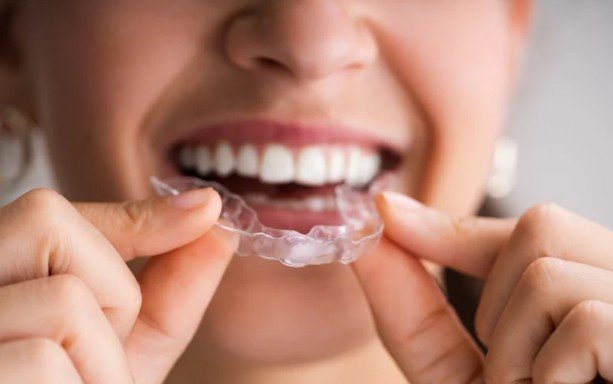
Most people wearing clear aligners are off by about seven hours a day, and they have no idea.
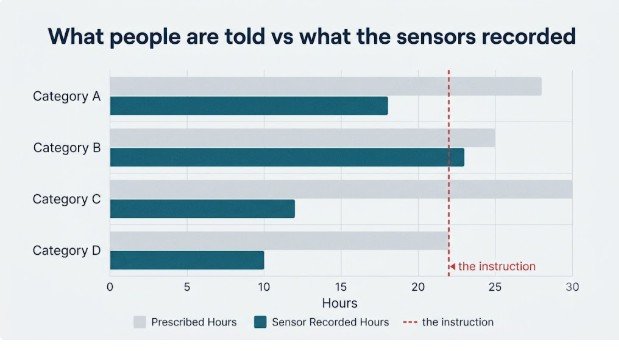
It’s not a guess – when scientists put temperature microsensors into the aligners worn 22 hours a day by 40 adult participants, they measured an average of 15.2 hours. Almost two-thirds of participants wore their aligners 10-20 hours a day. All participants thought they did the thing.
This problem never announces itself. People don’t get up one morning and decide to stop. The hours leak out in ten-minute pieces at dinner, in the car, during a long meeting, and the first real signal comes weeks later when a tray won’t seat right and the timeline slides, which is why the clinics that get good at this, including practices offering Invisalign selkirk, end up spending as much energy on a patient’s daily routine as on the tooth movement itself.
What follows is a look at what the wear-time research says about compliance in general, where your hours actually disappear, and the five-part system that holds up on the days you don’t feel like it.
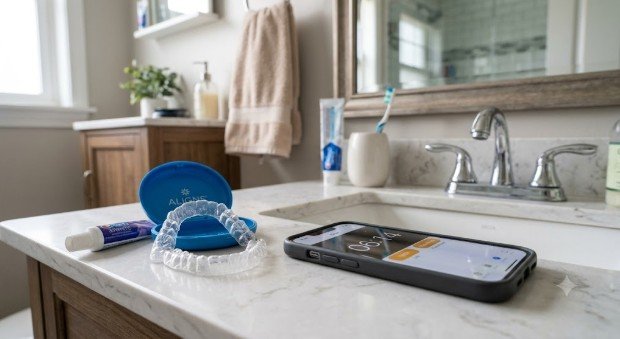
The 22-hour rule is a scheduling problem in a willpower costume
Ask anyone why they fell short and you’ll get some version of “I got lazy.” I don’t buy it, and the research doesn’t either.
Wendy Wood spent three decades at USC studying this, and her signature finding is that roughly 43% of what people do in a day gets repeated in the same context while they’re thinking about something else. Same kitchen. Same commute. Same seat on the couch at 8 pm. The room does the remembering, not your character.
That reframes the whole 22-hour thing. The trays come out in a restaurant where there’s nowhere to put them, or in a car with no case, or on a Friday when somebody else’s schedule quietly replaced yours, and each of those is a location failing you rather than a moment of weakness.
Willpower is what you’re left with after your environment stops helping.
What the wear-time numbers actually look like
Before you compare yourself to any of this, know that the honest version of the data is less flattering than any brochure and a lot more useful to you.
| Study/source | Prescribed wear | Measured wear | Gap |
| Microsensor RCT, 40 adults (AJO-DO) | 22 h/day | 15.2 h/day | 31% short |
| Same trial, monitoring-unaware group | 22 h/day | 13.7 h/day | 38% short |
| Same trial, monitoring-aware group | 22 h/day | 16.7 h/day | 24% short |
| Removable appliance review (Angle Orthodontist) | 15 h/day | ~7.65 h/day reported in earlier work | roughly half |
Awareness alone bought back 4.4 hours a day
Both groups in that trial had sensors in their trays. Only one group was told the sensors were measuring their compliance. The other group thought the chip was just logging temperature.
The difference between them was an increase of 4.41 hours a day, with a confidence interval of 1.88 to 6.93 and a p-value of 0.0011. Nobody got a lecture. Nobody got a new device. One sentence at the start of treatment was worth four extra hours a day for twelve weeks.
Sit with how strange that is. The measurement changed the behavior before anyone did anything with the measurement.
You’ve seen this everywhere else, too. The month you tracked every dollar was the month you spent less. The week you logged your runs was the week you ran. A study in Scientific Reports on automated electronic feedback during aligner treatment leaned on the same mechanic: patients logged wear time in an app, and anyone reporting under 22 hours got a nudge back.
The same trial found wear time dropped off at the later appointments, which is the pattern you’d expect once novelty stops carrying you, and the calendar has to do the work instead.
Sixty-six days, not twenty-one
You’ve been told the “21 days to build a habit” line, probably more than once. One of the strongest cases of baloney that exists within the realm of self-improvement literature stems from a book published in 1960, discussing how plastic surgery patients adjusted to their new face; far cry from the process that one will go through while using a tray.
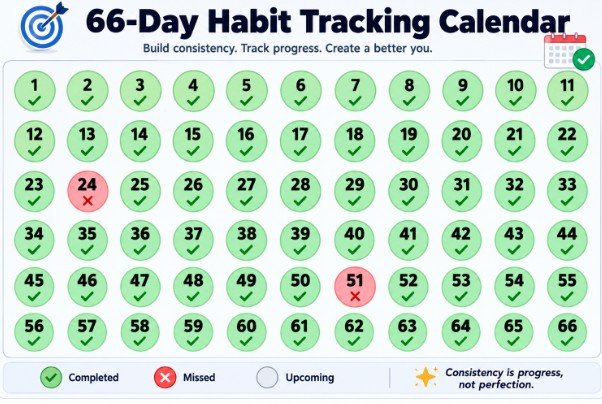
The research actually came out of University College London, performed by Phillippa Lally and her team in 2010. They studied 96 volunteers completing a task for 12 weeks, and found that the median time required to reach 95% of automaticity was 66 days. The range ran from 18 days to a projected 254.
Two things in that paper matter more than the headline number.
First, complexity drives the spread. Drinking a glass of water after breakfast automates fast. Something with multiple steps, a container, a cleaning routine, and a social cost takes a lot longer. Aligners are squarely in the second bucket, so if you’re on week three and it still feels like effort, you’re on schedule.
Second, and this is the part I’d tattoo on a tracking app: missing a single day did not break the curve. One skipped day is noise. The people who quit aren’t the ones who slipped. They’re the ones who decided the slip meant something about them.
Where the hours actually go
Pull apart a bad week, and it’s almost never mysterious. Five leaks account for most of it.
- The long dinner. Twenty minutes of eating turns into ninety minutes of talking. A commenter on Blind put it bluntly, admitting they averaged 18-plus hours instead of 22 and that taking the trays out before a dinner out was the awkward part. That’s the single biggest hole for adults.
- The coffee that never ends. Anything hot or colored means trays out. A mug you nurse for two hours costs you two hours.
- The bathroom counter. Trays come out at the sink, then you get distracted, then you leave the house. Now they’re home, and you’re not.
- Travel and weekends. Wood’s research found habits fire in stable contexts. Take away the context and the behavior often doesn’t fire at all, which is exactly why routines collapse on vacation.
- Month four. Motivation is highest at the start and thinnest in the middle, and the sensor data backs that up with wear time declining at later visits.
Every one of those five is a scheduling fix, which is why a decent check-in appointment asks about your week before it asks about your tray count. Clinics running Invisalign selkirk cases see the same five leaks over and over, and they can usually name yours faster than you can.
None of these are character flaws. They’re logistics.
Five moves that survive a bad week

This is the part worth stealing for anything else you’re trying to hold onto.
Attach the behavior to a place, not a mood. Case goes in the same pocket of the same bag, every day. When the cue is physical and fixed, you stop relying on remembering.
Make removal expensive and reinsertion cheap. Carry the case and a travel toothbrush. If putting them back in requires finding a bathroom, finding the case, and finding water, you’ll delay. Every step you delete buys you minutes back.
Set a hard stop on meals. Not “eat quickly.” Set a 45-minute timer when the trays come out. Arbitrary, visible, and it works because it converts a vague intention into a number you can fail or pass.
Track the gap, not the goal. Don’t log the 22. Log the hours out, which is a much smaller number and far easier to be honest about. Twelve weeks of that is your own personal version of the microsensor trial, and the trial says the tracking itself is doing real work.
Decide your recovery rule in advance. Write down what happens after a bad day, before you have one. Lally’s data says one miss is survivable. Your inner critic will tell you otherwise at 11 pm, so settle it while you’re calm.
What this transfers to
Clear aligners are one of the few commitments in adult life with a built-in scoreboard. Your teeth report your compliance whether you’re honest or not. There’s no talking your way past a tray that won’t seat.
That’s rare. Most goals let you fudge the record for months. The gym doesn’t text you. It’s not like your savings account is going to let you know what week you’ve become less consistent.
This means that since you’ve got to this point where you’ve been wearing your aligners for a couple of months now and have started getting results, you understand the following: consistency is more of a design issue, tracking is stronger than motivation, and we generally overestimate our consistency by about a third.